Showing posts with label Devi worship. Show all posts

Friday, April 28, 2023

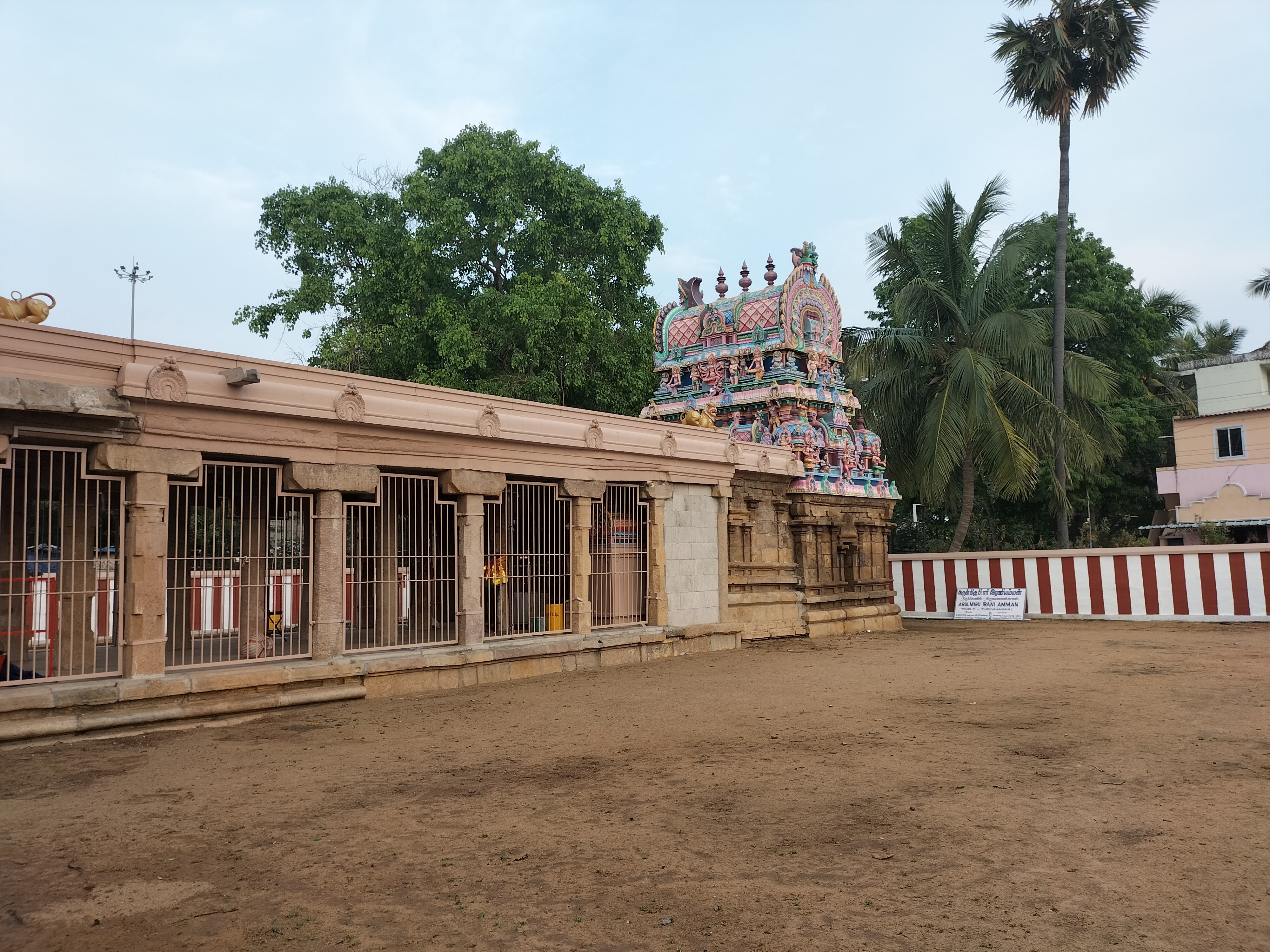
அருள்மிகு பிடாரி இரணியம்மன் கோயில்.

திருவானைக்கா எல்லை காவல் தெய்வம் இரணியம்மன். ஆனைக்கா கோயிலின் தென்கிழக்குப் பகுதியில், திருநீற்றான் மதிலுக்கு வெளியில் இவ்வாலயம் அமைந்துள்ளது. சிறிய கோயில். எனினும் மிகவும் அழகான, அமைதியான கோயில். 

வாசலில் குபேர கணபதி.

அதைத் தாண்டியதும் உடைந்த மதில். அதற்கு அருகில் பாதை போட்டுள்ளனர்.


பலிபீடம் உள்ளது; அதற்கு அடுத்து நுழைவாயில். 


வலம் வரும்போது மணல் வெளியில் சப்பாணி கருப்பர், சங்கிலி ஆண்டவர், காத்தவராயர், தங்கையாள், மதுரைவீரன் ஆகியோர் உள்ளனர். அய்யனாரின் குதிரை வாகனம் உள்ளது. அதற்கு எதிரில், சற்றுத் தள்ளி ஐயனார் சந்நிதி (வலம் வரும்போது பார்ப்போம்).


தொடர்ந்து நடக்கையில் கோயிலுக்குரிய கிணறு உள்ளது. கிணற்றில் தண்ணீர் இருக்கிறது. கோயிலின் மழைநீர் சேகரிப்பு அமைப்பு இக்கிணற்றில் விடப்பட்டுள்ளது.

தொடர்ந்து வருகையில், இரணியம்மன் கருவறையின் பின்புறம் வருகிறது. சற்று முன்னே செல்ல, கணபதி சந்நிதி. 


தொடர்ந்து மணல் வெளியில் நடக்க ஐயனார் சந்நிதி (முன்பே அறிமுகமானது). அதற்கு அடுத்து, தலமரமாக தற்போது இருக்கும் மருத மரம். ஆலமரமும் முன்பு இருந்தது; தற்போது இல்லை என்று அர்ச்சகர் தெரிவித்தார். மருதமரத்தின் அடியில் விநாயகர், நாகர், கிராம தேவதைகளின் சிலாரூபங்கள் (பழுதானவை) உள்ளன. இதற்கு அடுத்து பேச்சியம்மன் சந்நிதி உள்ளது.


இப்போது மூல தெய்வம் இரணியம்மன் சந்நிதி இருக்கும் மண்டபம் நோக்கிச் செல்கிறோம். நுழையும் போதே தேவியின் சிம்மம் நம்மை வரவேற்கிறது. உள்ளே செல்கிறோம்.

இரணியாசுரனை சம்ஹரிக்கும் கோலத்தில் அம்பாள் பெரிய வடிவோடு இருந்தாலும் பக்தர்களை இன்முகத்தோடு, முகத்தில் குறுநகை ததும்ப காட்சி அளிக்கிறாள்.

தரிசித்த பின், நமஸ்கரித்து விட்டு, மன நிறைவோடு திரும்புகிறோம்.


Friday, January 24, 2020

Satsangam - Thai Amavaasai post

வணக்கம்.

இன்று (24-01-2020), வெள்ளிக்கிழமை, தை அமாவாசை இரண்டும் சேர்ந்த புனித நாள்.

அரசன் ஒருவன், "இன்று என்ன நாள்?" என்றான், அம்பிகையை தியானித்துக் கொண்டிருந்த அபிராமி பட்டர், "இன்று பௌர்ணமி" என்று சொன்னார். கோபம் கொண்ட அரசன், "இன்று மாலை, நிலவு வருமா?" என்றான் அரசன். அம்பிகையின் பூரண சந்திர வதனத்தை, மனக்கண்ணில் கண்டு வந்த பட்டரோ, "அதற்கு என்ன? நிலவு வரும்." என்றார். ஒருவேளை நிலவு வரவில்லை எனில், தண்டனைக்கு உரியவனாவாய் என்றான் அரசன்.

மாலை வேளை வந்தது. வானில் நிலவு வரவில்லை. அபிராமி பட்டருக்கு, எல்லாமே அம்பிகை தான். அவர் வாயில் இருந்து வந்த வாக்கும், அந்த வாக்தேவியின் வாக்கே என்று நம்பிக்கை கொண்டிருந்தார். அன்னை அபிராமியை வணங்கி, பாடல்களைப் பாடத் தொடங்கினார். அப்பாடல்களே அபிராமி அந்தாதி. 79 ஆவது பாடலைப் பாடினார்.

விழிக்கே அருள் உண்டு, அபிராம வல்லிக்கு, வேதம் சொன்ன
வழிக்கே வழிபட நெஞ்சு உண்டு எமக்கு, அவ்வழி கிடக்க,
பழிக்கே சுழன்று, வெம் பாவங்களே செய்து, பாழ் நரகக்
குழிக்கே அழுந்தும் கயவர் தம்மோடு, என்ன கூட்டு இனியே?

இப்பாடலின் பொருள்:

அபிராமியின் விழிகளில் என்றும் அருளுண்டு. வேதமுறைப்படி அவளை வழிபட எனக்கு நெஞ்சமும் உண்டு. அப்படி இருக்க, பழியையும், பாவத்தையுமே விளைவித்து, பாழ் நரகக்குழியில் அழுந்தி வாடும் பேதையர்களோடு எனக்கு இனித் தொடர்பு வேண்டுமா? வேண்டவே வேண்டாம்.

இப்பாடலைப் பாடியதும், அன்னை, தன் அணிகலன் ஒன்றைக் கழற்றி, வானில் வீச, முழு நிலவாய், மாலை வானில் மிளிர்ந்தது. அரசன் முதலிய அனைவரும் அதிசயித்தனர். பட்டரின் விழியும் மனமும் குளிர்ந்தது.

ஸத்ஸங்கம் (நல்லாரோடு கூடுதல், சேர்தல்) என்பது எவ்வளவு முக்கியம் என்பதை வலியுறுத்தும் பாடலாக எனக்குத் தோன்றுகிறது. ஆதி சங்கரர், பஜ கோவிந்தம் ஸ்தோத்திரத்தில்,

ஸத்சங்கத்வே நிஸ்சங்கத்வம்
நிஸ்சங்கத்வே நிர்மோஹத்வம்
நிர்மோஹத்வே நிஸ்சலதத்வம்
நிஸ்சலதத்வே ஜீவன்முக்தி:

என்கிறார்.

ஸத்சங்கத்தில் இருந்தால் பற்றை விடலாம். பற்றை விட்டால் அழிவு வராது. அழிவு இல்லை எனில், அறிவு வரும். அறிவு வந்தால், முக்தி பெறலாம்.

திவ்ய ப்ரபந்தம் - முதல் திருவந்தாதி, பொய்கை ஆழ்வார் எழுதியதில், பத்தாம் திருமொழி, ஐந்தாம் பாடலில்,

நா வாயில் உண்டே நமோநாரணா என்று
ஓவாது உரைக்கும் உரை உண்டே - மூவாத
மாக்கதிக்கண் செல்லும் வகை உண்டே, என்னொருவர்
தீக்கதிக்கண் செல்லும் திறம்.

நம் வாயில், நாக்கு உள்ளது. அதனால் "நமோ நாரணா" என்று பகவன் நாமத்தை, மந்திரத்தைச் சொல்லக்கூடிய திறம் உண்டு. மாறுதல் (அழிவு) இல்லாத நல்ல வழிக்குச் செல்லும் வழியும் உண்டு. அப்படி இருக்க, தீய வழியில் எதற்காக ஒருவர் செல்ல வேண்டும்? அப்படி விழும் அவர்கள் திறமைத்தான் என்னே!

என்று பாடுகிறார்.

ஆண்டாள் நாச்சியாரும், திருப்பாவைப் பாடல்களில், கூடி இருந்து குளிர்ந்தேலோர் எம்பாவாய் என்று கூடாரை வெல்லும் சீர் பாடலில் பாடுகிறார். சங்கத் தமிழ் மாலை என்றே சொல்கிறாள். சங்கம் என்றால் கூட்டம். எல்லோரும் சேர்ந்து, இறைவனை வழிபட்டு, பெற்ற பேற்றினைப் பற்றிப் பாடுகிறாள். பகவத் கைங்கர்யம் என்பதே அந்தப் பேறு.

எல்லாரும் ஒன்று சேர்ந்து, நல் வழியில் செல்ல வேண்டும் என்று தான் நம் பெரியோர்கள், முன்னோர்கள் சொல்லி இருக்கிறார்கள். அவர்களது வாக்கைப் புரிந்து கொண்டு, நல்ல வழியில் நாமும் சேர்ந்து செல்வோம்.

ஸத்சங்கம் எல்லாருக்கும் கிட்ட, இறைவன் அருள் வேண்டி,
சரண்யா

Wednesday, May 16, 2018

Anbil Mariyamman Temple

Next temple to be seen is Mariyamman Temple in Anbil. This temple is located on the main road itself, contrary to Shiva temple, which is some half km interior to the main road.

Right now kumbabhishekam works are going on. Previously there was no compound wall. Now, they have constructed a long compound wall. One can see sannidhis for Ayyanaar, Madhurai veeran and other grama devathaas outside the main temple.

Main temple has a big mandapam, hosting the dwajasthambam, bali peetam. Several devotees come and stay in the temple to get cured of ailments. The ambal in this temple is considered to be the younger sister of Samayapuram Mariyamman.

Ambal is seen as a huge deity, sitting with one leg folded and the other leg let down on the head of an asura. She has eight hands. Trident, Sword, Rope, axe, kunguma container, bow in six hands and other two hands show varada - abhaya mudras.

A swayambu lingam is also seen in the garba griham, in front of ambal.Ganesha and Renuka devi idols are also present before the garbagriham. Very powerful deity, as told by many in and around the place. We could see several devotees on padha yatthirai to Samayapuram offer their prayers to Anbil Mariyamman.

Hope after kumbabhishekam, we can see the temple in a better shape.

Few photos:
https://drive.google.com/open?id=19-AkyP7OuXSOq1_dIVfK8Yg4av2fyy_q

Friday, March 10, 2017

Devi's Naamaa

Today 10-03-2017, Friday morning at 6.15 I had a chance to listen to the speech of Shri P.Swaminathan in Podhigai TV. He was sharing an experience related to Shree Lalitha Sahasranamam. I wanted to share with you the same.

In a village, there lived a scholar who was very well versed in Lalitha Sahsranama and other sanskrit granthaas. He was also so proud of his knowledge and was always asking whoever he meets, some questions related to sahasranamam and will make fun of them as they don't know the answer for the same. This was a routine thing happening over there and the poor people could not do anything. They respected his knowledge. So they remained calm.

Ok. Our Maathaa Lalithamba is Omniscient, Omnipresent and Omnipotent. All are her children. If a child does some mischief on his or her siblings, the mother will interfere at some point of time. Lalithamba is not an exception to it. Indeed she loves to play with us, Her child.

The scholar met a man who looks after cows in that village. He has nearly 50 cows with him. He use to feed them, give bath to them and clean the places. He does nothing other than this noble task of Go samrakshana.

The scholar asked the man if he knows to recite Lalitha Sahasranama. The man replied, "I don't know that and all. Also it wont be easy for him to recite. But I have heard it being recited in the temple on Fridays. I have 50 cows with me. I have named them with the names that came in the sloka and also easy for me to call - like Sandhya, Savithri, Gayathri, Saraswathi, Lakshmi, Kamala etc.. Daily I use to meet each of that 50 cows atleast 20 times and inquire them like -

'Kamala, did you drink water?'
'Savithri, have you finished eating the hay?'
'Saraswathi, finished eating the fodder?'

so on.

The scholar could realize a sudden blow on his head. From that moment onwards he saw the cattle herd as Lord Krishna. He started to respect people and he stayed away from mocking at people.

What we have to take from this is - we need to be humble. Reciting naamaas with correct pronunciation is important. But reciting them with utmost love to Devi is more important. So let us not stay away from reciting God's naama having we don't know the proper pronunciation as a reason. Start saying. Pronunciation will be coming perfectly in the due course of time with the God's grace.

Saint Valmiki who was a thief in the previous birth, got upadesam from Sage Narada - the word "ma-ra". He kept chanting mara mara mara mara till his death in that birth. Ultimately rama rama rama rama came from his mouth. Then came the Rama avatara and Valmiki wrote the epic Ramayana!

The sound of the bell comes first. Then the Elephant. 

Wednesday, January 07, 2015

Thirunedungalam

This is one of the 275 paadal Petra sivasthalam. Eighth sthalam on the southern banks of river Kaveri in the chola mandala. This is located near Thuvakudi, in Trichy district. Saint poet Thirugnanasambandar has composed a pathigam, 10 slokas and a phalasthuthi on The Lord here. That is called by the name, "idar kalaiyum nedungala thiruppathigam". Please see here for the text. 


Also, arunagirinathar has sung a tiruppugazh on the subrahmanya shrine here. Few verses on this temple are also found in arunagirinathar's Kandhar alankaram.


Lord shiva is called as nithya sundareswara or nedungalanathar and goddess Parvati is called by name, mangalambika or oppillanayaki. A mid sized water tank is at the entrance of the temple. 


Temple tank
Lord Ganesha and lord muruga are on the two sides of the entrance. Then comes the rajagopuram, which has several sculptures depicting purana stories, like ravana rendering sama gana with one of his head and hand as veena and some more. Then comes the dwajasthambam, Bali peetam. Nandi is in front of the peetam.

Main Entrance
Nandhi, bali peetam
To the right side is the sannidhi of ambal, mangalambika. There is a mandapam where the utsavar idols are kept during festival days after procession. 


Ambal Sannidhi
Mandapam where utsava idols are kept

Further as we move in,there is another gopuram with lot more sculptures. We see the nataraja sivakami sannidhi to our right. We cross another gate to see lord shiva. Here this nedungalanathar is a swayambu murthy. I.e. It appeared on its own, without the involvement of anyone. The linga is small in size and it is moved a little, to accommodate ambal to it's left. Ambal performed tapas here and attained lord shiva, in this kshetra.

Outside the sanctum sanctorum, Ganesha and muruga are seated on either side. We go around the prakaram and there are lot of small idols of saptha kannikai(brahmmi, vaarahi, maaheswari, koumari, chaamundi, indrani, vaishnavi), shiva lingas, Sri Devi, bhumi Devi sametha narayanan, subrahmanya with his consorts valli and devasena. On the back side of shiva sannidhi,there is ardhanaareeswara. 

Two gopurams above the garbha griham - similar to Kashi

Saptha Kannikas


Varadaraja perumal with Bhoomi devi and Sri devi

Subrahmanya
Ardhanaareeswarar

Theertham in this temple is agastya theertham and there is ample water in the well, so close to our hands!


Navagraha in this temple is a unique one. All eight grahas face lord surya who is west faced here. Normally surya is east facing. So there is a difference in the arrangement of the nine planets. 

Normal arrangement of 9 grahas

Angaragan - sukran - Chandran
Guru           - suryan - Budhan 
Ragu          - sani      -  kethu

Each graha face different directions.

Sivagama prathishta
Budhan     - Chandran - ragu
Angaragan - suryan     - Sukran
Sani           - guru        - kethu

All face surya and surya faces west.

Then there sandikeswara, bhairava, somaskanda sannidhis. There is also a vahana mandapam, having horse, bull, peacock, nandhi. This kshetra is equivalent to kashi or Varanasi kshetra. There will be two gopurams above the garbage graham as it is in kashi.

Vahana Mandapam

Let us pray to the lord, to slay all our sorrows. Idar agattruvaai Nedungalanatha! Aum Nama Sivaaya.

Sunday, May 18, 2014

Tiruveezhimizhalai

This temple is located on the banks of Arasal aaru (A distributary of Kavery river, Hari sol aaru, meaning the movement of the river will produce a sound hari hari). Being praised by saivaite saints Appar, Sudarar, Sambandar and Manikkavachagar, this is one of the paadal petra sthalam in Chola nadu, on the southern bank of Kavery river. Reference to Arasal aaru, read this earlier post.

Lord Shiva is known by the name Veezhinaathar and his better half is known by the name Sundara kujambigai in this temple. A huge tank (full of water) welcomes  the devotees. This is indeed a treat to our eyes. In these days, where temple tanks are giving a parched sight, this is infact a boon to us. Opposite to the tank is the main gopuram (small in size) which leads to another large gopuram with full of sculptures depicting Shiva ganas, nataraja's dance etc. Before entering this gopuram, to the right one could see a majestic hall, but completely dark. This is known by the name vowaal mandapam (hall of bats), mainly due to non usage of the hall. The roof architecture of this hall resembles chidambaram temple. Once upon a time the celestial marriage celebrations were performed in this hall. But now a days since the population has grown and due to some difficulties in providing lighting arrangements, this celebrations are shifted inside the temple premises in a open hall. Marriage is performed to the utsava moorthis, kalyanasundara moorthi - kathyayani ambal in the month of chithirai on magam nakshatram day. This is performed in the evening time.

Mahavishnu's chakra lost its power and it was by worshipping lord shiva here, he got back his chakra in full power. He performed pooja with 1008 lotus flowers. While completing he was short of one flower and for that he offered his one eye as a lotus. Shiva was happy with that and asked Vishnu to take back his chakra from the temple tank. Hence the name veezhinathar (nethrarpaneswarar).

By worshipping lord shiva, one could get the illness related to eyes cured. Also by worshipping kalyanasundaramoorthi and kathyayani, unmarried ones could get married to good individuals.

We enter the large gopuram and find ourself amidtst broad open prakara that hosts the dwijasthambam and bali peetam. In front of this is a peetam where the lord offered coins to saint Tirugnanasambandar. Further we find a mandapam and this has a lingam Tirumoolanathar.

We come around this outer prakaram and there are three other peetams on the other three sides. Peetam where Saint Sundarar is offered jewels, then on the back side there is the peetam where Saint Tirunavukkarasar was offered coins. Here we find the sannidhi of padikkasu vinayakar who offered coins to the saints on behalf of Lord Siva, during famine times, for building the temple. We also see another gopuram after this sannidhi. We come to the prakaram and move further to find the peetam where manikkavachagar was shown the paadam by the lord. There is also a separate small sannidhi for mahalinga swamy and mayuranatha swamy.

We come to inner prakaram, where there are two temples. One for Veezhinathar and the other for Sundarakujambigai. Before entering the sannidhi, there is a nandhi which is located at a lower level. This is known as Patala nandhi.

There are few steps known as maasa padi, to climb the main sannidhi. On the other side, for exit, there are another set of steps known as Graha padi. We enter the sanctum sanctorum of Veezhinatha peruman. There behind the linga, there are idols of Siva - Parvati in kalyana kolam. Very few temples have these kind of arrangements in the garba graham. To the right, there is the sannidhi of Kalyanasundaramoorthi and Kathyayani in kalyana kolam. There is also a nandhi to the left of Siva. The arrangement is in such a way that siva keeps his hand on nandhi in a resting posture.

Inside the mandapam hosting garba graham, there are places for other utsava idols like Balambal, Bikshandar, Mahavishnu(getting his chakra back by bathing in the temple tank) and few more.

We come around this inner prakara and we see Dakshinamoorthi. Here there is no muyalagan below his feet. Instead, his feet rests on a lotus. There is a hole on the back side of siva sannidhi through which parrots use to worship lord shiva daily. Usually, lingothbhavar will be in this place in all other temples. This is a rare one. There are many other linga structures like Ekambreswarar. The sthala vruksha is Jack tree (palaa maram). Even now a days in villages in and around this place, in all houses there will be jack trees and jack fruit is one of the favourite fruit for the people here. The vahanas are also present in the mandapams in this prakaram. Other sannidhis for Nataraja - Sivakami, Vaidyanathar, Suryan, Chandran, Bhairavar, Murga, Irattai Vinayakar are seen in the front entrance of ths prakaram.

We then enter the temple of sundarakujambikai (azhagiya mamulai amman). This too has a gopuram, to enter from the outer prakaram, but it is rarely opened. Normally we enter from shiva temple. This gopuram has sculptures, predominantly female deities. This has a sannidhi where sundarakujambigai blesses her devotees in a standing posture. With four hands, top two holding sangu and chakra and bottom two with varada abhaya mudras, this deity is said to have beautiful breasts full of grace and hence the name azhagiya mamulai amman. There is a sannidhi for Vinayaka on one side and Muruga on the other side in this prakara.

This temple is maintained by Tiruvavaduthurai aadheenam. Nice temple to have darshan.

Saturday, May 10, 2014

Uttamar Kovil

This temple has something special and unique when compared to all other temples. Yes.. This has the shrines of Brahmma, Vishnu and Shiva with their consorts. Vishnu is known by the name Purushottama perumal and hence the name of the place - Uttamar Kovil. Goddess Lakshmi is known as Pooranavalli thayar, who grants the boon to give a complete satisfaction to the devotees. Shiva is known by the name Bikshandar and this place has another name - Bikshandar kovil too. Soundarya Parvathi is the name of Lord shiva's consort in this temple. As the name says, the ambal is so beautiful. For lord Brahmma who does not have a form in this bhoolokha, this temple is an exception. There is a separate sannidhi for Brahmma. Goddess Saraswathi with veena, akshamala also sits in a separate sannidhi, bestowing boons to the people is found in this temple. This is one of 108 divya desams (praised by Tirumangai alwar) and is known by the name Thirukkarambanoor and the sthala vruksham is Banana tree. Banana are found to be grown on the banks of river cauvery. One more temple tiruppaigneele near Trichy is also said to have banana as sthala vruksham.

This is a small temple in terms of area. If we enter from No.1 tollgate bus stop, past Kollidam (coleroon) river in Trichy, we are welcomed by a dwajasthambam. Before that stands the garudazhwar (Periya thiruvadi) sannidhi. Opposite to this is the shrine of Purushottama perumal. Perumal lays on his serpent aadhi sesha - similar to Sri Ranganatha swamy of Srirangam. To the left of this sannidhi is Sri Mahalakshmi thayar, who is adorned with beautiful ornaments. To the right of perumal sannidhi is the sanctum sanctoram of Hanuman(Chiriya thiruvadi). All these are built with in a mandapam. To the left of this mandapam is another mandapam, that hosts the sannidhi of Poorana valli thaayar.

We come around the temple to find the small sannidhis of Twin Vinayaka (Irattai pillayar), Bala lingam (a tiny lingam). Then we come to the Dakshina moorthi sannidhi. Here they call dakshinamoorthi as Siva guru. Then we enter a hall which has the shrines of Bikshandar and Soundarya parvathi (sakthi guru). Nandi deva stands in front of Bikshandar. There are also some idols of utsava moorthis, Lord Subrahmanya, vinayaka in this hall.

Again in the path where we circum ambulate, we find the sannidhis of Lord Rama with Sita, Lakshmana and Hanuman and a separate sannidhi for Lakshmi Narayana.

We cross the nandi and reach a small mandapam that has the sannidhi of Lord Venugopala. we move further to see the navagraha sannidhis and Durgai amman. There is another small sannidhi of Lingam that was worshipped by King Dasaratha and the name of that lingam itself is Dasaratha lingam.

We complete the round and come near the dwajasthambam in front of perumal. There on our side we find another mandapam hosting sannidhis of Varadharaja perumal (called as vishnu guru), aazhwars. Brahmma and saraswathi are seated in separate sannidhis.

This sthala is also known by the name saptha guru sthalam. They are Deva guru (brahaspathi), Asura guru (Sukracharya), Siva guru (Dakshina moorthi), Sakthi guru (Soundarya parvathi), Vishnu guru (Varadharaja perumal), Brahmma guru (Brahmma), Gnana guru (Subrahmanya).

Wednesday, May 07, 2014

Tirunelveli


No sooner did I utter this name, immediate thought of the famous halwa (a sweet made out of wheat and sugar) comes to our mind. Also known by another name Nellai, this is an important, siva sthala, situated on the banks of river Tamiraparani (shuddha tamraparni thadasthitham as pointed out by Muthuswami dikshitar in his kriti Sri Kantimatim in hemavathy). Out of pancha maha sabhai (5 sacred halls), this is thamira sabhai (copper hall). Lord Nataraja's dance was seen by saints in these 5 halls.

1. Kanaka sabhai (Hall of gold) - Tillai (chidambaram)
2. Velli ambalam (Hall of silver) - Aalavai (Madurai)
3. Rathna Sabhai (Hall of gems) - Tiruvalangadu
4. Chitra Sabhai (Hall of paintings) - Tirukuttralam
5. Thamira Sabhai (Hall of copper) - Tirunelveli (Nellai)

In all the 4 places except Madurai, Nataraja's right leg is on the ground and left leg lifted. In Madurai alone, it is reversed (right leg lifted and left leg on the ground).

As soon as we enter the Nellaiappar temple, we could see the kerala type architecture on the ceilings interior to the main entrance. A big nandhi (constructed during recent times) welcomes you. Then we can see the dwajasthambam and a small nandhi (ancient one). Further if you go inside, there is the sannidhi of Nellaiappar. But it is customary to first see Kanthimathi amman sannidhi first. So we circumambulate the prakaram. We enter a sannidhi where Vinayaka, Shiva (in linga form) and Parvati were seated under a roof, with Nandi deva infront of them. Then we further go inside to see a hall full of sculptured pillars with yali. In two of those pillars we could see Hanuman and Sugreeva. Near Hanuman carved pillar, we find the sannidhi of Mahishasura Mardhini. To the left we see the temple tank. On the banks of the tank we see lot of lingas named, Kashi viswanatha. The tank is considered to be as pure as the Ganges.

We further cross the hall, to enter the prakaram of Kanthimathi amman. We see the thousand pillared hall and the oonjal mandapam, where ambal sits on the swing during the month of Aadi (in this month, valaikappu function is celebrated for amman) and Chitirai (during kalyana utsavam). We enter Kanthimathi amman's sannidhi. Oh... one could feel like hugging her.. for she is full of grace. On the day when I saw her, she was wearing a yellow coloured cotton saree, so simple... but I got a feeling that a child will get after seeing her mother after a long time. coming out of Kanthimathi amman temple, we could see Mahalingaswamy sannidhi and few more shiva lingams.

On the other side we were welcomed by the temple elephant (Kanthimathi). She blessed us. For her the authorites have put 3 ceiling fans to enable her to sleep without any disturbance during night. Its a move to be welcomed. We came across the ancient temple of Mahalinga swamy which is located below the ground level. Due to passage of time, it went down, as I could hear from the temple authorities. To its right there is the Nellaiappar sannidhi. The entrance is adorned by pillars holding sculptures of Karnan, Arjunan, Veerabhadran and one more siva gana with garland made of human skulls. All were very realistic. Both Kanthimathi amman temple and nellaiappar temple are famous for the musical pillars. There are few pillars in the amman temple and more in siva temple. One could hear Sa Ri Ga Ma Pa in a set of pillars. One could hear the sound of jalatharangam, tabla in others.

Nellaiappar is swayambu (self created). So the shape of linga is not that perfect. There is a cut that passes from top right to centre. Interesting thing here in the sanctum sanctorum is, there is a sannidhi for Vishnu. Named as Nellai Govindar, vishnu lays on the serpent bed, performing pooja to another siva lingam (just like ananthapadmanabhaswamy). There is also a utsava moorthi for Vishnnu, with a kamandalam in his hands, standing after performing marriage of his sister Kanthimathi  with Nellaiappar.

There is also a Shanmukar sannidhi. Unique thing here is, the six faces of muruga were placed symmetrically that from the front we could see three faces and the other three faces could be seen from the back side only. Here Indra himself stands as peacock. Normally asura will be peacock. In that case peacock's beak will be on Muruga's right side. If deva is a peacock, it's beak will be on Muruga's left side. Realistic Sculptures of Manmadhan (with a romantic smile) and Rathi adornes the entrance to Muruga's sannidhi. There is an image of Sri chakram painted before the entrance of murugan's sannidhi.

Another stunning shrine is Sandana nataraja (Nataraja will always be bathed in sandal paste). There is a hall before this sannidhi which is decorated by wood carvings.

This temple is larger than madurai temple. Also well maintained and very clean and tidy.

Wednesday, April 09, 2014

Rama Namam

With prayers to Lord Rama on the day after Sri Rama Navami of Vijaya Samvatsaram (2014 April 08), I am writing this blog.

Rama is a two letter mantra derived out of the ashtakshara (Aum Na mo Na ra ya na ya) and Panchakshara (Na ma Shi va ya) as we all know. Many saints have spoken about the power of this RaMa nama.

Goddess Parvathi asked Lord Shiva which is told in Sri Vishnu Sahasranama of the Mahabharata epic. "Keno Payena lakuna vishnoor naama sahasrakam - Patyathe pandithair nithyam srothumicchyaamyaham Prabho". She asked, "how a lay man can achieve the fruits of reciting vishnu sahasranama that can be read by learned person?". Lord Shiva answered, "Just tell rama rama rama. Rama nama has the essence of Vishnu sahasranama or 1000 names of Lord Vishnu". This is told in the sloka "sri raAa rAma rAmEthi ramE rAmE manOramE sahasranAma thathulyam rAma nAma varAnane".

In my childhood days I have heard a bhajan "Rama namame kalkandu" i.e. Rama nama is sugar crystals. This is the taste of nama. Bhadrachala Ramadasa, an ardent devotee of Rama sings, "Entha ruchira rama yemi ruchira - sri rama ni namam yemi ruchira - O rama ni namam entha ruchi". How sweet is rama namam... aaah.. so sweet... he says.

A composer Tanjore Shankara Iyer, sings in his composition -
Maduram maduram sri ramanamam
Manadhirkku inbam alithidum namam
Yedhu vandhu nammai yedhirtha podhum
Innarul purindhu rakshikum namam
Yenniya karumangal inidhe mudiyum
Rama nama mahimai adhuve aagum
Vinnavarum Pottrum tharaka manthram
Veeramum alithidum avan thiru namam

Rama namam is so sweet as a nectar. It gives happiness to the mind. Whatever comes in our way as an obstacle, Rama namam will protect us. What we desire to have, we get it. That is the prowess of the nama. The celestials too sing the pride of this taraka mantra and it installs bravery in one's heart.

After performing several crores of Ramanama, even in 19th century, one great soul got the vision of Sri Rama with his Bow. He is Saint Tyagaraja. He has composed numerous songs on Lord Rama. Who is equal to you Rama?, he asks in his kriti Rama Ni samanam evaru. Also he says Rama nama will give such a comfort to one who says it in another kriti Sukhi evvaro rama nama. In another kriti "rama katha sudha", he says Listening to Ramayana is so soothing and one will get dharma, artha, dhairya and ananda and more good deeds. Above all, rama bhakti (devotion to rama) will fetch you kingdom (Rama bhakti Samrajya).

The power of Rama nama is depicted by Hanuman (Ever living - chiranjeevi). He crossed the ocean by chanting the Rama nama. Rama built a bridge across the ocean to reach Lanka, but hanuman just like that crossed the Ocean by just chanting Rama nama. So this means, Rama nama is mightier than Lord Rama himself.

A small song (composer unknown) depicts the characteristics of rama nama.

Ramanin namame tharaka namam
Vendum varangalai thandhidum namam
Anjanai maindhan aanjaneyanukku
alaikadal thandida udhaviya namam
Jai jai ram ram jai seetha ram

Narayana enum ashtaksharathil
Ra venum aksharam olithidume - adhu
Namasivaya enum panchaksharathil
Ma enum jeevanil inaindhidume
thondriyadhe rama namame
thudhithiduvome rama namame
Jai jai ram ram jai seetha ram

Hariyum Sivanum ondre endru
anaivarum unarndhu thudhippome
Igaparam irandilum inbam alithidum
Inai yilla namam thudhippome
Adiyavar idargalai pokkidum namam
Arumarundhagiya annalin namam
Amudhamanaya sri ramanin namatthai
anudinam paadi avanarul peruvom
Jai jai ram ram jai seetha ram

Ramanamam is the tharaka namam, that gives all you want. It helped Hanuman to cross the ocean. It was born out of the ashtakshara and panchakshara mantras. Let us all chant it. Hari and siva are one and Rama nama gives happiness both in this birth and in the next birth. It erases the difficulties of the deveotees, cures the illness. Let us all chant the nectar like Rama nama daily and get His blessings.

Nanmaiyum Selvamum naalum nalgume
Thinmayum Papamum sidhaindhu theyume
Janmamum maranamum indri theerume
Immaiye Ra Ma yendra irandu yezhuthinal

As quouted by Kambar in his Kamba Ramayanam, if one says RaMa in this birth, it will give him goodness, money for ever. His sorrow, sins will all be evacuated. He will be free from births and deaths. Let us all chant Rama Nama whenever possible (atleast 12 times a day) and get His blessings.

One more note: Samartha Ramadas (who was guru of Chatrapati Sivaji) was an ardent devotee of Rama. He has asked Rama to go in front of a person who has chanted RamaNama 13 crore times in his life. Also he asked Rama to keep the count himself as human may make mistakes while counting. So Rama's Bow (Kodhandam) which has a bell will hit once if a devotee completes 1 crore name. With this the devotees work is easy. He need not have to keep count. He need not bother about that. His only work is to chant Rama nama. Let us start from today.

Rama Rama Rama Rama..........

Friday, July 31, 2009

Varalakshmi Vrittham


Today, July 31, 2009 (Adi 15, 5110 Kali Era, VirOdhi) - Varalakshmi Virutham.

Sri Muthuswami Dikshitar who is known for his variety of kritis has written a song for this occasion too. This kriti, Sri varalakshmi is set to sree raagam roopaka taalam.

The composer starts with the rAgamudrA.

pallavi
shrI varalakshmI namastubhyam vasupradE
shrI sArasapadE rasapadE sapadE padE padE

Salutations to sri varalakshmi, whose feet are like lotus, graceful at every step. She bestows fortune to us. Here if you see, dikshitar has used the words brilliantlly.

sArasapadE
rasapadE
sapadE
padE


anupallavi

bhAvaja janaka prANa
vallabhE suvarNAbhE
bhAnukOTi samAna prabhE
bhakta sulabhE

sEvakajana pAlinyai
shrita pankaja mAlinyai
kEvalaguNa shAlinyai
kEshava hrta khElinyai


She is the life of Mahavishnu who is the creator of bhAvaja (manmadhan). She shines like a gold. Her brightness is equivalent to crores of suns. She can be easily reached by her devotees.

She protects her devotees, wears garland made up of lotus, embodiment good and unique virtues, plays in the heart of kEshavA.

caraNam

shrAvaNa pUrNimA pUrvastha shukravaarE
chArumatI prabhrtibhih poojita kArE
dEvAdi guruguha samarpita maNimayahArE
dInajana samrakshaNanipuNa kanaka dhArE

bhAvanA bhEdachaturE bhAratI sannutavarE
kaivalyavitaraNaparE kAnkshitaphalapradakarE

In the month of ShrAvaNa (Aadi - AavaNi), on the full moon day falling on Friday, she is worshipped by women like chArumati. She wears the garland of gems offered by Devas and guruguha (dikshitar) and she is an expert in protecting the afflicted. She resembles golden showers (kanakadhArA). She knows to differentiate emotions, is worshipped by BhArati (saraswati). She grants salvation and boons.

If you listen to this kriti, you can notice how brilliantly dikshitar has given the day on which this pooja need to be performed. His kritis are definitely an encyclopedia.

Let the goddess Varalakshmi grant all good things to all of us.

Thursday, July 30, 2009

Navaratri - NavAvarNa kritis


sree mAthA sree mahA rAgnee sree math simhAsanEswari
sree chakrarAja nilayA sree math tripurasundari
sree sivA siva sakthyaikya roopini lalithAmbikA

May goddess Lalita bless all of us.

In this blog, I am going to compare the sree chakram description (description about the 9 stages of the sree chakram) as told in brahmmANda purANam with Sri Muthuswamy Dikshithar's navAvarNa kritis. 1 kriti for each day.


Day 1:
* The first aavarnam of sri chakram is called as Bhoopuram.
* It is a square with three concentric layers.
* In the outermost layer, there are 10 shaktis starting with Anima, Mahima and so on.
* In the middle layer, there are 8 shaktis, starting with BrahmayA.
* In the inner layer, there are 10 shaktis. They are the 10 mudrA shaktis. (Lalita sahasranama quote - dasamudrA samArAdhyA).
* The chakram is called as trilOkyamOhana chakram.
* Property of the chakram - Enchanting the three worlds.


Head of the chakram - TripurA.
Yogini's name - Prakata

Dikshithar's kriti - KamalAmbam samrakshatumAm in the rAga Ananda Bhairavi, holds description of this chakra as:

"tripurAdhi chakrEswari AnimAdhi siddheeswari nitya kAmEswari kshitripura trilOka mOhana chakravarthani prakata yOgini ..."


Day 2:
* The second aavarnam of the sri chakram is sOdashadhalam.
* Its a 16 petaled lotus.
* It has 16 shaktis, starting from kAmakarshini.
* It is headed by TripurEsi.
* Chakra Name - sarvAsa paripUrakam
* Property - Fulfills all expectations
* Yoginis - Gupta Yoginis


Dikshitar's kamalAmbam bajarE in the raga kalyani, describes this chakram as follows:

In the charanam, "sarvaasa paripooraka chakra swaminim paramasiva kaminim durvasarchitha gupta yoginim.."


Day 3:
* The third aavarnam of the sri chakram is ashtadhalam.
* Its a 8 petaled lotus.
* It has 8 shaktis, starting from AnangA, kusumA.
* It is headed by Tripura sundari.
* Chakra Name - sarvasamkshObana
* Property - Agitates all
* Yoginis - Gupta tara Yoginis


Dikshitar's shree kamalAmbikayam katAkshithOham in the raga sankarAbaraNam, describes this chakram as follows:

Charanam has these lines - "Anangakusumaashta sakthyaakaaraaya aruna varna samkshobana chakrakaraya anantakoty anda nayaka sankara nayikaya ashta vargatmaka gupta taraya varaya anangadyupasitaya ashtadhalabja sthithaya.."


Day 4:
* The fourth aavarnam of the sri chakram is called as chathur dasAram.
* It has 14 triangles, with a shakti in each.
* The 14 shaktis starting from samkshObini are headed by Tripura vAsini.
* The chakrA nAme is called as sarva sowbhagyadAyakam.
* This chakra grants excellence.
* The yOginis are called as sampradAya yogini.


Kambodhi rAga kriti - kamalAmbikAyayai describes this aavarnam as:

"sakala saubhagyadayakamboja charanayai, samkshobhinyaadi shakti yuta chathurtha varanaayai, prakata chathurdasa bhuvana bharanaayai, prabala guruguha sampradayaantha kaaranyaayai"


Day 5:
* The fifth aavarnam of the sri chakram is known as bahir dasAram or outer 10 triangles.
* Each triangle has a shakti.
* The ten shaktis starting from sarva siddhi prada are headed by TripurAsri.
* The yOginis are called as kulOtterNa yoginis.
* The name of the chakram is called as sarvArtha sAdhakam.
* Property of this aavarnam or chakram is it helps in accomplishing all activities.


Dikshitar's bhairavi rAga kriti "sree kamalAmbikayaah param nahirE" describes the aavarnam as follows:

Charanam has the lines, "naadamaya sookshmaroopa sarva siddhi pradaadhi dasaasakthya aradhitha murthey, …. Aadhi madhyaantha rahithaprameya guruguha moditha sarvaartha saadhaka...


Day 6:
* The 6th aavarnam is called as Anthar dasAram (inner 10 triangles)
* There are 10 shaktis starting with SarvagyA and are headed by Tripura MAlini.
* The aavarnam is also called as sarva rakshAkaram
* This protects all.
* Yogini - Nigarbha yogini.


Dikshithar's Punnagavarali kriti kamalambikayastava describes this aavarnam as follows:

Charanam has the lines, "dasakalaatmaka vahni swaroopa prakasa antar dasaara sarva rakshaakara chakreswarya tridasaadinutha kacha varga dvya maya sarvagyadi dasa sakthi sameta malini chakreswarya… dasakarana vrutti marichi nigarbha yoginyam"


Day 7:
* The 7th aavarnam is called as ashtakonam that has 8 triangles.
* There are 8 shaktis starting from vashini. They are the 8 vaag devis who were responsible for organising 1000 names of Lalita as sahasranAmam.
* The yoginis are rahasya yoginis.
* The chakram is called sarva rOgahara chakram.
* It evacuvates all diseases.
* Tripura siddha heads this chakram.


SahAnA raga kriti sree kamalambikayam bhaktim karOmi describes:

"…virinchi harisana hari haya vedhita rahasya yoginyam paraadi vaag devathaa roopa vasinyaadhi vibhaaginyaam charaathmaka sarva rOga hara niraamya raja yoginyam…"


Day 8:
* The 8th aavarnam is called as trikOnam (a triangle).
* There are 3 shakthis starting with kameshwari. One shakti at each side of triangle.
* TripurAmba heads this aavarnam.
* It is also called as sarvasiddhi prada chakram.
* This chakram grants all perfection.
* Yogini - Athi rahasya yogini


Dikshithar's Ghanta raga kriti shree kamlambike avaava describes as follows:

Anupallavi has the lines - "lokapalini kapalini soolini loka janani, bhagamaalini chakradalokya maam sarva siddhi pradayike tripurambike balambike".

In the charanam the following lines come - "….santapahara trigonagehe sakameswarisakthi samuhe …. Yanta raga pasa dvesha ankusha dara kare ati rahasya yogini pare"

Day 9:
* The 9th aavarnam is the Bindu Mandalam.
* Here is the Maha shakthi - Maha Tripura Sundari.
* The yogini is called as paraaparaadhi yogini.
* The chakram is called as sarvAnandamaya chakram, that grants divine bliss.

The deity Lalithamba resides here at the bindu in the chintamani griham, on a simhasanam that is made up of 5 brahmmams (Brahmma, Vishnu, Rudran, Easwaran and Sadasivan) who performs the 5 functions (srishti, sthithi, samharam, thirOdhanam and anugraham).
She sits on the lap of Lord Kameshwara and rules the world. Chintamani griham is surrounded by kadamba vanam and is situated on the sumeru mountains.

sivakameshwarangastha siva swadheena vallabha
SumEru madhya srungastha sriman nagara naayika
chintamani grihanthastha pancha brhammasanasthitha
maha padmaata veesamstha kadamba vana vasini


Dikshithar's sree kamalamba jayati in the raga Ahiri describes as follows:

Pallavi has a line "sripura bindu madhyastha chintamani mandirastha".
Anupallavi has lines, "sukarananadyarchita mahatripurasundarim rajarajeswarim, srikara sarvanandamaya chakra vasinim, suvasinim.."

MangalasAsana kriti - srI kamalAmbikE shivE pAhimAm in the rAgam sree is an apt end to the navAvarNa series. The composer describes the real form of dEvi sitAsitE (sitha asitha - meaning fair and dark). He describes her as the auspicious one, worshipped by vishnu and she will always be with Shiva (siva sahitE). Her face is like a full moon and she is the friend of saraswati and lakshmi. She protects all her devotees and grant boons to them.

Let Lalita protects all of us.

Thursday, April 03, 2008

War against Bandasuran

Bandasuran, a devil who use to give lot of troubles to the good people was killed by dEvi upon the requests that came from the dEvAs, saints and others. This episode has been well described by the following slokas.

Devi came to the rescue of her bhakthAs when they are troubled by bandasuran. She killed him with the help of her 6 shakthis -
1. Sampathkaree headed the elephant army
2. Ashwarooda headed the crores of horses
3. Manthrini - Lalitha's minister
4. Dhandini or vaaraahi - Lalitha's army chief
5. Jwaalaamaalini - One who created fire fortress to protect Lalitha's army.
6. Bala - A nine year old, ever young girl who is very dear to Lalitha.

Sampathkaree and Ashwarooda headed the elephants and horses army respectively. All the weapons that are needed are placed in a chariot called chakra raja ratham that has 9 plates.

Manthrini came on the chariot - geyachakra ratham that has 7 plates and Dhandinee came on the kirichakra ratham that has 5 plates.

To protect Lalitha's army from the enemies, Jwaalaamaalini created a fire fortress.

Manthrini killed vishangan, Bandasuran's minister while Dhandinee killed visukran, Bandasuran's army chief. Baalaa killed the 30 sons of Bandasuran and got the appreciation from Lalitha. All these people made Bandasuran to run away from the war field due to the fear of getting killed by Lalitha's weapons. Suddenly, Bandasuran placed an yantra called "vigna yantra" that gave a state of sleep to all by the side of Lalitha. To overcome that, Lalitha gave a smile by seeing lord Kameshwara's face and created, Maha Ganapati who neutralised the effect of vigna yantra. So Lalitha's army proceeded towards the victory.

This victory against Bandasuran was praised by Brahmma, Vishnu (upendra) and Indran and others under them. They all worshipped devi sri Lalitha.

This is narrated in the following slokas.

dEvarshikana sangAtptha sthUyamAnAthma vaibhavA
bandasura vadhOthyuktha sakthi sEnA samanvitha
sampathkaree samArooda sindhoora vraja sEvitha
ashwAroodAthishtithA ashwakOti kOti birAvrutha

chakrarAja rathArooda sarvAyutha parishkruthA
gEyachakra rathArooda manthrini parisEvithA
kirichakra rathArooda dhandanAtha puraskruthA
jwAlAmAlini kAkshiptha vahnni prAkAramadhyakA

bandasainya vadhOthyuktha sakthi vikramaharshithA
nithyA parAkramAtopa nireekshana samudhsukhA
banda puthra vadhOthyuktha bAlA vikramananditA
manthrinyambA virachitha vishanga vadha thoshithA

vishukra prAna haraNa vArAhee veerya nandithA
kAmEshwara mukhAlokhA kalpithasree ganEshwarA
mahA ganEsha nirbinna vignayantra praharshithA
bandAsurEndra nirmuktha sashtraprathyasthra varshini

karAngulinakothpanna nArAyana dasAkruthi
mahApAsupathAsthrAgni nirdakthasura sainikA
kAmeshwarAsthra nirdaktha sabandAsura soonyaka
brahmmOpendra mahEndrAdi dEvasamsthutha vaibhava

Let us all pray Lalitha to kill all our enemies and grant us a peaceful life.

Tuesday, April 01, 2008

Kavi Kaalamegam

Kaalamegam was a dull person without any knowledge. But he was an ardent devotee of the goddess Akilandeswari. People use to make fun of him. Dejected by the behaviour of the people around him, Kaalamegam went to the temple and prayed to Akilandeswari to grant him knowledge.

Understanding the difficulty of her son, Akilandeswari disguised herself as an ordinary woman, wearing a white coloured saree. The woman appeared before Kaalamegam. She was chewing betel leaves. She asked Kaalamegam to open his mouth and transferred the betel leaves in her mouth to his mouth. Immediately the woman disappeared. Kaalamegam felt asleep on the sannidhi of Akilandeswari. The temple authorities didnt notice him and they locked the temple and went to their home.

On the next day, when kaalamegam woke up, he was frightened to see the temple authorites in front of him. They started beating him, suspecting he has come inside with an intention to steal the jewels of Akilandeswari.

Then came the surprise. No sooner did the authorities started beating him, than he came up with awesome songs in the praise of the goddess Akilandeswari. All were stunned up with this incident. Kaalamegam, beleived to be a dull person is now surprising all with beautiful songs. They patiently inquired what happened. He narrated the incident. All came to a conclusion that the goddess has granted him the knowledge. Kaalamegam was then called "Kavi Kaalamegam", "Kaalamega Pulavar". He is famous for a type of poem called - "slEdai" - A word will imply two meanings. This type of poem is used to compare two objects with a single word.

Since she gave vidya (knowledge) to Kaalamega kavi during the evening time, Akilandeswari is worshipped as Saraswathi in the evening time. Akilandeswari is the collection of three shakthis (Iccha, Kriya, Gnana). She is worshipped as Lakshmi (Iccha shakthi) in the morning, Parvati (Kriya shakthi) in the noon and as Saraswathi (Gnana shakthi) in the evening.

Kundalini sakthi

Kundalini is dEvi's sookshma sareeram (non physical form). It is present in the moolaadhara chakram in a coiled fashion. The coil or the concentric circle has three and half rounds.

The sakthi when induced properly by yOga, starts to flow from the moolAdhAra chakram into the swAdhishtAna chakram through a gap called Brahmmagranthi. From there to the manipoorachakram. From manipooram it flows through the vishnugranthi into the anAhata chakram and then to the vishuddhi chakram, Aagya chakram. From Agya chakram to the sahasraara chakram through the rudragranthi. Siva resides on the sahasraara chakram. Siva is immovable. So sakthi who is movable, in the form of kundalini flows from moolaadhaaram to sahasraaram and makes siva to bathe in the ocean of happiness (sudha saarabhi varshini).

This is given in the following lines of the lalita sahasranama.

moolAdhAraika nilayA brahmmagranthi vibEdini
manipoorAbja nilayA vishnugranthi vibEdini
aagyAchakrAntharAlastha rudragranthi vibEdini
sahasrArAmbujAroodA sudhA sArAbhivarshini
thatillatha samaruchi shatchakrO parisamsthitha
mahAsakthihi kundalini bisathanthu dhaneeyasi

7 yoginis

There are 7 chakraas in our body. They are moolAdharam (end of the vertebral column), swAdhishtAnam (Above the moolaadhaaram), manipooram (At the back of the stomach in the navel region), vishuddhi (At the back of the throat), anAhatham (in the heart), aagyA (between eye brows), sahasrAram (on the central part of the head).

Lalitha sahasranamam says in each of these chakram, a yogini is sitting and governing the functioning of the parts associated with it. The detailed description is given below.

1. TAkini

vishuddhi chakra nilayA ArakthavarnA thrilOchana
katvAngAthi praharanA vadhanaikka samanvidha
pAyasAnna priyA thwakshtha pashu lOkha bayankari
amruthAdhi mahAsakthi samvruthA tAkineeswari


TAkini resides on the vishuddhi chakram. She is red coloured (Arakthavarna). She has three eyes. She holds weapons starting from katvaangam. She is one headed (vadhanaikka). Payasam (sweetened milk) is her favourite. She destroys the fear of samsaara sagaram (or re births). She is surrounded by sakthis with Amrutha as the first one.

2. RAkini

anAhatAbja nilayA shyAmAba vadhanadwayA
dhamshtrojwala akshamAlA ditharA rudira samsthitha
kAlarAdryAdhi sakthyowga vrudhA snikdhowdhanapriya
mahA veerendra varadhA rAkinyamba swaroopini


RAkini resides in the anaahatha chakram. She is black coloured with two heads. She holds an akshamaala (garland). Kaalaraadhri leads the shakthis pertaining to her. She likes ghee rice. She is worshipped by great warriors.

3. LAkini

manipoorAbja nilayA vadhanathryaya samyutha
vajrAdhikAyudhopedha dAmaryAdhi birAvradha
rakthavarna mAmsanishta kutAnna preetha mAnasa
samastha bhaktha sukhatha lAkinyambA swaroopini


LAkini resides in the manipoora chakram. She has 3 heads. She holds weapons like vajraayudham. Her shakthis include daamari and others. She likes flesh and other fatty items (kutaanna preetha maanasa). She gives comfort to the devotees.

4. KAkini

swAdhishtAnAmbjakatha chatur vakthra manOharA
shoolAdhyAyutha sampannA peethavarnA athigarvitha
mEdhonishta madhupreetha bandhinyAdhi samanvidha
dhadhyanna saktha hrudaya kAkini roopadhArini


KAkini resides in the swadhishtaana chakram. She is 4 headed. She holds weapons like the trishoolam. She is yellow complexioned (peetha varna). She is very much proud about herself (athi garvitha). She likes honey. Curd rice is her favourite. She has sakthis starting from bandhini.


5. SAkini

moolAdhArAmbujarooda panchavakthrAdhi samsthitha
angushAdhipraharana varadhAdhi nishEvithA
muthgowdhanA sakthachitthA sAkinyambA swaroopini


SAkini lives at the moolaadhaara chakram with 5 heads. She holds angusham and some more weapons. Her sakthis start from varadha. She likes rice prepared out of grams and dal.

6. HAkini

AagyA chakrAbjanilayA shuklavarnA shadAnana
majja samstha hamsavathee mukhya sakthi samanvidha
haridrAnnaika rasika hAkini roopadhArini


HAkini lives at the AgyA chakram. She is white complexioned and has 6 heads. She resides in the tissues. Her shakthis are hamsavathi and kshamaavathi. She likes turmeric rice.

7. YAkini

sahasradhala padmasthA sarvavarnOpa shObhitha
sarvAyudhadarA shukla samsthitha sarvathOmukhi
sarvowdhanA preetha chittha yAkinyambA swaroopini


YAkini resides at the sahasrAra chakram. She is multi coloured and has all the weapons. She has many faces. She likes all food items.

Monday, March 31, 2008

Sree Vidya Ramayanam

Introduction

Sree Vidya Ramayanam is a version of Ramayana (the story of Lord Rama) that is based out of Devi Sree Lalitha. This says, Lalitha rules the world and all the happenings in Ramayana are also by the orders of Lalitha.


Overview

The story of Ramayana as per Srividya ramayanam is as follows.

This starts with the conversation between Agastya and Hayagreeva. Agastya asks Hayagreeva to explain him the Guhya thathvam (secret philosophy) of Brahmmanda purana. Hayagreeva explains it to Agastya as follows.

Once Indra wanted to test the lovely couple (Agalya - Gauthama). So Indra disguised himself as a cock and went to Gauthama's ashram before the day dawned. By making sound like a cock, Indra tricked Gauthama and the latter went out to the river bank for having bath thinking that the day had dawned. At the ashram Agalya was left alone. Indra appeared as Gauthama and tried to misbehave with Agalya. Agalya being a pathi vrathai (one who never thinks of a man other than her husband) and a Devi bhakthai (devotee), found out the intention that Indra was having in his mind and prayed to Devi to save her and make Indra realise his mistake.

Initially before starting for execution of this task, Indra (also a devi devotee) prayed to Devi to protect him in case of any trouble. So after listening to Agalya's plea to save her, Devi turned Agalya into a stone. Now neither Indra nor Agalya would get a bad name.

Indra realised his mistake on seeing Agalya turning into a stone. Gauthama on seeing Indra at his ashram and agalya turned into a stone, judged what could have happened with the prowess of his tapas (meditation).


Origin of Sree vidya ramayanam

To kill the asuras Lalitha originated from the "chith agni kundam" and after killing asuras she married Lord Kameshwara (form of Lord shiva, adorned with jewels). Every body was happy. but Gauthama was still thinking of Agalya. On seeing this, Lalitha announced that everyone including herself will suffer for not helping Agalya at the time of her difficulty in the Ramayana time.

So she said "My form Narayanee will be born as Rama and Narayanan will be born as Lakshman. Form of Parameswara and Brahmma will be born as Bharatha and Chatruguna.

Indra who troubled Agalya is similar to monkey. So he was borne as Sugreeva, the monkey king.

Like Gowthama who suffered a lot from being separated from his wife, Rama, Sugreeva will also need to pay their debt. (Rama and sita wil part and similarly sugreeva and Tara)


Relation to Ramayana

Kausalya, Kaikeyi and Sumitra, wives of King Dasaratha of Ayodhya were ardent devotees of Sree Lalitha, Parameswara and Brahmma,Vishnu respectively. They prayed to their favourite deities and got child(ren) of their choice. Kausalya gave birth to Rama (Devi's form), Kaikeyi to Bharatha (Parameswara's form) and sumitra gave birth to Lakshmana (Vishnu's form) and Chathruguna (Brahmma's form).

The rest are similar to Ramayana by Valmiki. But all happenings are centered at Devi's command.


End Notes

Many versions of Ramayana exists. We cant say this is the right one or so. All are aimed at increasing one's faith towards God. If we take the situation where all including Devi herself are suffering the punishment for not helping Agalya, we can conclude that even God need to repay his debts. This is the wonderful principle of equality.

This Sree vidya ramayana, enforces optimism. If one thinks positively

1. All that happened will seem to be good

2. All that is happening will be good.

3. All that will happen will also be good.

Sri chakram - description

Sri chakram has 9 levels. The description of each level from external to internal is given below.

1. Bhoopuram
This is also called TrilokyamOhana chakram. This chakram enchants the three worlds. The type of yogini in this stage is Prakata yogini. There are totally 28 sakthis - 10 starting with AnimA, 8 starting with Brahmya and 10 mudra sakthis. Tripura is the head for this stage.

2. Shodasa Dalam
The second stage, called as sarvAsa paripUraka chakram fulfills all expectations. Yogini at this stage is Gupta yogini. Tripuresi heads this chakra. There are 16 sakthis starting from kAmAkarshini.

3. Ashta Dalam
This stage is known by the name sarva samkshObana chakram. This agitates all. The gupta tara yoginis are headed by Tripurasundari. There are 8 sakthis starting from ananga, kusuma.

4. Chaturdasaram
The 14 sakthis starting from samkshobini is headed by tripuravAsini. They are the sampradAya yoginis who grants excellence. This stage is also called sarva saubhAgyadAyaka chakram.

5. Bahirdasaram - 10 outer sakthis
The sarvArtha sAdhaka chakram that has 10 sakthis starting from sarva siddhi prada allows one to accomplish all tasks. This stage is headed by tripurasri. They are kulOtheerna yoginis.

6. Antardasaram - 10 inner sakthis
The sarva rakshAkara chakram that has 10 sakthis starting from sarvagyA protects all. This stage is headed by Tripura Malini. They are Nigarba yoginis.

7. Ashtakonam
The 8 sakthis starting from vasini is headed by tripurasiddhA. They are the rahasya yoginis who cures all ailments. This stage is also called sarva rOgahara chakram.

8. Trikonam
The eighth stage, called as sarva siddhiprada chakram grants all perfection. Yogini at this stage is athi rahasya yogini. Tripuramba heads this chakra. There are 3 sakthis starting from kAmeswari.

9. Bindu
The ninth stage, called as sarvAnandamaya chakram grants bliss. Yogini at this stage is parA parAthi yogini. Maha Tripura Sundari is the sakthi in this chakra.

One of the greatest composer sri Muthuswamy dikshithar has written a set of nine kritis - one for each level of the sri chakram under the name - kamalAmba navA varna kritis.

Lalitha Sahasranamam

Origin of LalithA SahasranAmam

LalithA sahasranAmam is a powerful mantra pertaining to Devi worship. It is a hymn that is belived to be originated by the divine order from sree lalithAmbika. This hymn is a collection of thousand names of lalithA. They had been arranged in such a way, describing devi from her head to foot (also called as 'kesAdhi pAdham'). Following this description, comes the description of the sri puram which is located at the centre of the sumEru mountains - the place where lalithAmba resides. Then comes the description of her throne, war against bandAsuran, sookshma swaroopam (or to be imagined) as the kundalini sakthi and some more.

At the 7th level, Ashtagonam or sarva rOgahara chakram of the 9 level sri chakram, the 8 vAg dEvathAs or speech influencing powers reside. They are vasini,kAmeswari,arunA,vimalA,jayinee,modhinee,sarvEswari,kowlini. These 8 saktis compiled this sahasranAmam.

How the sahasranAmam was made available to humans?

Saint AgastyA, who accepted lord Hayagreeva (form of vishnu with a horse face) who is very brilliant as his guru. One day when Hayagreeva came to Agastya's house, the latter asked the former to enlighten him on the divine lalithA sahasranAmA. HayagreevA became happy and taught AgastyA the sahasranAmA. Thus it was made accessible to humans.

Power of LalithA sahasranAmA

LalithA sahasranAmA grants good health and prosperity to all who recites it. The slOkA prevents early death due to ailments and grants long life.